Tube Screamer Clone
AbstractMy take on the classic Ibanez Tube Screamer, but altered to be a bit simpler and tuned to my guitar and amp combo, and taste.

The Ibanez Tube Screamer is a classic guitar pedal. It's an overdrive pedal known for its warm mid focused sound. It can either be used as a clean boost to push the amp into overdrive or you can crank the gain and allow the internal diodes to clip. A well known song that uses it is Fade to black by Metallica.
After seeing Electrosmash's circuit analysis on the Ibanez Tube Screamer, I decided to have a go at building one. I chose to forgo the complicated JFET bypass circuit for two reasons. It looks unnecessarily complex and the JFETs required are hard to source in South Africa without paying extreme shipping fees for inexpensive components. An off-the-shelf stomp switch is a much more elegant solution. I first breadboarded the circuit replacing the BJT input and output buffers with op-amp ones. I really liked the clipping from the diodes — you get that classic rock sound. But I wasn't too happy with how much the output tone cut the highs. Because of this I simplified the circuit.
Firstly I removed the input buffer and instead put a 470 kΩ between the non-inverting input and Vbias. This way the input impedance is matched to the original tube screamer without needing the extra BJT input buffer. Then I removed the active tone control and used a passive RC tone controller just like what is already on the guitar. This simply tames the high frequencies and gets rid of the harshness produced by the diode clipping.
For the components, all the resistors are metal film 1%, all the critical capacitors are polyester film; the rest are electrolytic. I chose the TL072 because it works nicely with a single 9V supply and has the required performance for audio requirements. It's a jellybean part that's available at most electronics retailers. The diodes are just standard 1N4148s — they are very cheap and available everywhere.
Once I had a finalised circuit, I went to the lab at my university and hooked it up to an oscilloscope. I just wanted to make sure the gain and clipping were working as expected and that I was getting the desired frequency response. Everything looked nice on the scope, so I continued with building the circuit. I wanted to try my hand at "dead-bug prototyping". Dead-bug is where you solder everything together without a PCB. It is a real old-style way of doing it. It ended up looking a bit like a rat's nest on the inside but that's okay. Sometimes it's function over form. I have to say, I do like the dead-bug look even though it can be a bit tedious if there are multiple connections or if you have made an error in your layout. It is definitely something I will continue to do on non-critical stuff going forward.
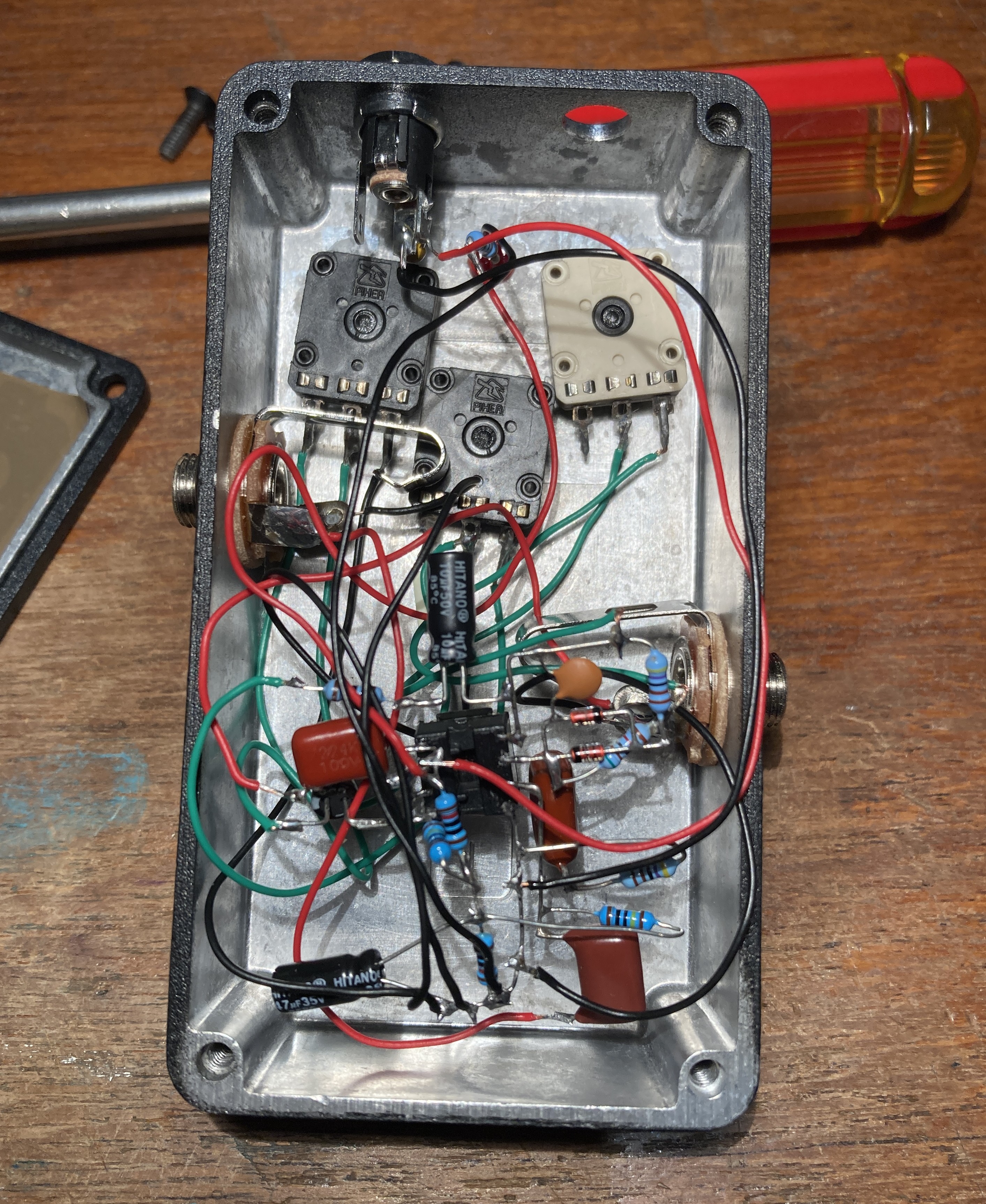
I bought a Hammond 1590B aluminium enclosure from Communica. The 1590B is the standard go to for DIY guitar pedals. I made a simple drilling template in Onshape and drilled out all of the necessary holes on my drill press. Drilling through the aluminium was easy and the holes finished up nicely with a deburring tool. I am not a huge fan of the black paint as it is a little boring but Communica didn't have the bare aluminium one in stock. I plan to give it a custom paint job in the future, not too sure what, but for now it does the job.
All the components were sourced from Communica and Mantech.
Overall this project was a really nice way to get into guitar pedal making. It's quite simple and does more on the inside than, say, a fuzz pedal or just a tone stack. I certainly learned a lot from it.
Specification
| Topology | Single DIP8 TL072 utilising one stage for gain and diode clipping and another for an output buffer, with a passive tone stack and volume control between them |
| Features | Input high-pass filter, gain control, diode clipping, output tone control, and volume control |
| Enclosure | Hammond 1590B aluminium |